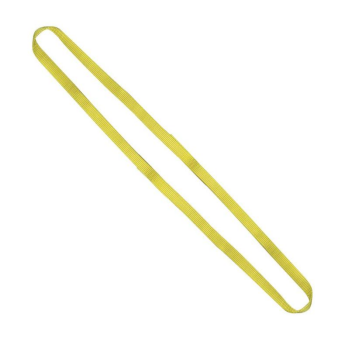
Flat endless webbing slings are important tools used to lift heavy items safely and easily. They are made of strong synthetic materials like polyester and are sewn into a loop shape, which is why they are called “endless.” These slings are soft, flexible, and lightweight. Unlike chains or steel ropes, webbing slings won’t damage the surface of the object they lift. People use them in many different places, such as warehouses, factories, shipyards, and construction sites. Because of their wide use, there are clear rules that say how these slings should be made and used safely. These rules are called standards, and the two most common ones are the European standard and the American standard.https://htsling.com/product-category/flat-endless-sling/
What Is the European Standard?
The European standard for webbing slings is called EN 1492-1. It is followed in most European countries, and also in many places across Asia, the Middle East, and Africa. One of the special features of the EN standard is its color system. Each lifting capacity has a fixed color. For example, a 1-ton sling is purple, a 2-ton sling is green, and a 3-ton sling is yellow. This system helps workers quickly identify how much weight the sling can lift just by looking at the color. It makes using slings more convenient and safer.
Another important part of the EN standard is the safety factor. For endless webbing slings, the European rule requires a 7:1 safety factor. That means if the sling is made to lift 1 ton safely, it must only break when the weight reaches at least 7 tons. This high safety factor helps reduce the risk of accidents. Each sling also comes with a label that includes clear information: the working load limit (WLL), the material, the EN standard number, the manufacturer, and a CE mark. If a sling does not have this label, it should not be used.
| Color coded according to EN1492-1 | Working Load Limit with 1 webbing sling | Working Load Limit with 2 webbing slings | |||||||||
| Straight lift | Choked lift | 0-7 | β | Straight lift up to 45 | Choked lift up to 45 | Straight lift 45-60 | Choked lift 45-60 | ||||
| 0-7 | 7-45 | 45-60 | 45-60 | ||||||||
| 1.0 | 0.8 | 2.0 | 1.4 | 1.0 | 0.7 | 0.5 | 1.4 | 1.12 | 1.0 | 0.8 | |
| WLL1T | 1,000 | 800 | 2,000 | 1,400 | 1,000 | 700 | 500 | 1,400 | 1,120 | 1,000 | 800 |
| WLL2T | 2,000 | 1,600 | 4,000 | 2,800 | 2,000 | 1,400 | 1,000 | 2,800 | 2,240 | 2,000 | 1,600 |
| WLL3T | 3,000 | 2,400 | 6,000 | 4,200 | 3,000 | 2,100 | 1,500 | 4,200 | 3,360 | 3,000 | 2,400 |
| WLL4T | 4,000 | 3,200 | 8,000 | 5,600 | 4,000 | 2,800 | 2,000 | 5,600 | 4,480 | 4,000 | 3,200 |
| WLL5T | 5,000 | 4,000 | 10,000 | 7,000 | 5,000 | 3,500 | 2,500 | 7,000 | 5,600 | 5,000 | 4,000 |
| WLL6T | 6,000 | 4,800 | 12,000 | 8,400 | 6,000 | 4,200 | 3,000 | 8,400 | 6,720 | 6,000 | 4,800 |
| WLL8T | 8,000 | 6,400 | 16,000 | 11,200 | 8,000 | 5,600 | 4,000 | 11,200 | 8,960 | 8,000 | 6,400 |

What Is the American Standard?
The American standard for webbing slings is different in a few ways. In the U.S. and some other regions like Canada and South America, the rules come from ASME B30.9 or WSTDA. These standards are also strict about safety, but they don’t use the same color system. In fact, slings made under the American standard can be any color, and the color doesn’t show how much weight they can carry. To find out the lifting capacity, you must look at the label.
The safety factor for American slings is usually 5:1, which is lower than the European standard. This means a sling designed to lift 1 ton must only break after reaching 5 tons. While this is still safe when used correctly, the margin for extra safety is smaller. The label on an ASME or WSTDA sling will normally include the working load limit, the manufacturer’s name or logo, a product code or serial number, and the standard name. It might also say “Made in the USA” or show the country of origin. Some labels also include care instructions or inspection reminders.
| Series | Type I,II,III,and IV | Two-leg or Single Basket | |||||
| Single-leg | Horizontal Angle | ||||||
| Hitch Type Width(in.) | Vertical | choke | Vertical basket | 60 deg | 45 deg | 30 deg | |
| Class 5 | 1 | 2200 | 1760 | 4400 | 4400 | 3800 | 3100 |
| 1 1/2 | 3300 | 2640 | 6600 | 6600 | 5700 | 4700 | |
| 1 3/4 | 3800 | 3040 | 7600 | 7600 | 6600 | 5400 | |
| 2 | 4400 | 3520 | 8800 | 8800 | 7600 | 6200 | |
| 3 | 6600 | 5280 | 13200 | 13200 | 11400 | 9300 | |
| 4 | 8200 | 6560 | 16400 | 16400 | 14200 | 11600 | |
| 5 | 10200 | 8160 | 20400 | 20400 | 17700 | 14400 | |
| 6 | 12300 | 9840 | 24600 | 24600 | 21300 | 17400 | |
| Class 7 | 1 | 3100 | 2480 | 6200 | 6200 | 5400 | 4400 |
| 1 1/2 | 4700 | 3760 | 9400 | 9400 | 8100 | 6600 | |
| 1 3/4 | 5400 | 4320 | 10800 | 10800 | 9400 | 7600 | |
| 2 | 6200 | 4960 | 12400 | 12400 | 10700 | 8800 | |
| 3 | 8800 | 7040 | 17600 | 17600 | 15200 | 12400 | |
| 4 | 11000 | 8800 | 22000 | 22000 | 19100 | 15600 | |
| 5 | 13700 | 10960 | 27400 | 27400 | 23700 | 19400 | |
| 6 | 16500 | 13200 | 33000 | 33000 | 28600 | 23000 | |
| 8 | 22750 | 18200 | 42350 | 42350 | 36700 | 29900 | |
| 10 | 28400 | 22720 | 52900 | 52900 | 45800 | 37400 | |
| 12 | 34100 | 27280 | 63500 | 63500 | 55000 | 44900 | |
Differences Between EN and ASME Standards
While both standards are made for safety, there are several clear differences between them. The first and most noticeable is the color. European slings follow a fixed color system, while American slings do not. This makes EN slings easier to recognize at a glance, especially on a busy job site. Another difference is the safety factor. EN slings use a 7:1 ratio, and ASME slings usually use 5:1. This means EN slings offer a slightly higher level of safety under the same load conditions.
The information shown on the sling labels is also different. EN slings include the CE mark and EN number, showing they follow European safety laws. American slings include ASME or WSTDA codes, and sometimes a serial number or batch ID. In terms of design, European slings for the same weight are often a bit wider than American slings. For example, a 2-ton EN sling is usually 60mm wide, while a 2-ton ASME sling might be around 50mm. This isn’t a rule, but it’s something you may notice when comparing the two side by side.
How to Tell Them Apart
When you have a sling in hand, there are a few simple ways to recognize whether it’s made to EN or ASME standards. The best way is to read the label. If you see EN 1492-1 and a CE mark, then it’s a European sling. If you see ASME B30.9 or WSTDA, then it’s an American sling. Checking the safety factor on the label can also help. If it says 7:1, it’s probably European. If it says 5:1, it’s likely American.
Looking at the color can also give you a clue. If the sling is purple, green, yellow, red, brown, blue, or orange and matches the European color code, then it most likely follows the EN standard. If the color seems random or doesn’t match any known system, it may be made according to ASME or WSTDA rules. The sling’s width can give another small clue since EN slings are often a bit wider than ASME ones for the same lifting strength.
Which One Should You Use?
Both European and American standard slings are safe and well-tested, but which one you choose depends on where you are and what your customer or project requires. In most European countries and nearby regions, only EN slings are accepted on worksites. In the U.S. and Canada, ASME or WSTDA slings are more commonly used and often required. If you work in sales or trade, it’s important to ask your customers which standard they prefer. Using the wrong standard may lead to problems with customs, safety checks, or end-user approval.
Conclusion
Flat endless webbing slings are useful tools for lifting heavy loads safely and easily. While European and American slings are both strong and reliable, they follow different rules for design, labeling, color, and safety factors. By learning the key differences — especially the label details, color systems, and safety ratings — you can quickly tell them apart and choose the right sling for your needs. No matter which type you use, always check the label, inspect the sling before each use, and follow proper lifting practices to keep everyone safe.